
Swing Plans, Jacking Plans & Rigging Plans Explained
Successful machinery moving doesn’t rely only on lifting power it’s about precision engineering.
Professional engineers will first calculate how the load will move, where the forces will act, and how the risks can be removed before any machinery is lifted, turned, or moved. This is the point at which swing plans, jacking plans, and rigging plans become instrumental in ensuring safe and controlled operations.
Knowing these plans can be a good tool to understand why seasoned machinery movers never take any project for granted and always prepare thoroughly.
Why Engineering Plans Matter in Machinery Moving
Heavy machinery is hardly ever moved in broad, empty spaces. In fact, most machinery relocation projects are done within a cramped factory layout, under low ceiling heights, and in the vicinity of existing structures such as pipes, cables, or operating equipment.
Floor load limits, narrow access ways, and the presence of ongoing operations nearby also contribute to the complexity of the situation. Such environments hardly provide space for errors. A small mistake without a proper engineering plan can lead to damaged equipment, structural failure, safety incidents, or costly project delays. This is why seasoned machinery movers depend on thoroughly engineered planning instead of guesses making certain that every move is carried out safely, efficiently, and with complete control.
What Is a Swing Plan?
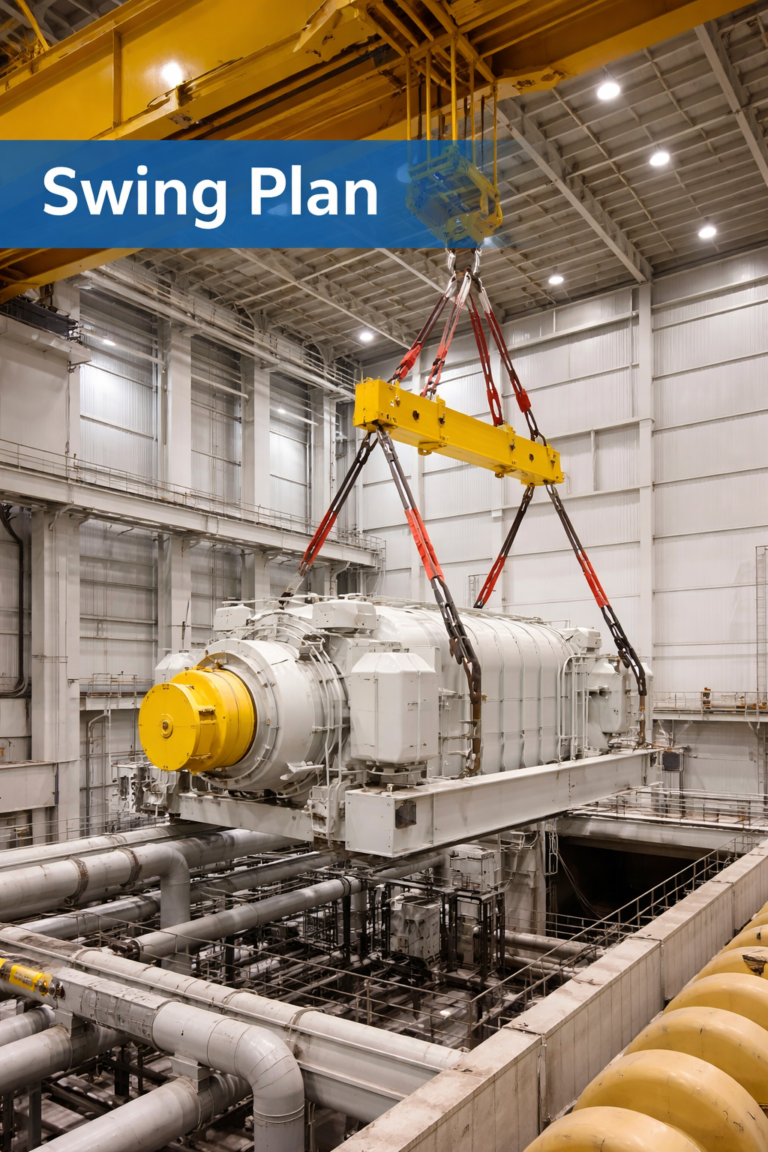
A swing plan defines how machinery will be rotated, pivoted, or swung during a lift or relocation. It becomes especially critical when space is limited, the load is long or bulky, or the machinery needs to turn around corners or pass through tight obstacles. In such cases, an uncontrolled motion can turn what would have been a normal lifting procedure into one that is risky.
As the load swings, its centre of gravity changes. Unless this operation is well thought out and controlled, the machinery may hit the adjacent structures, become unbalanced when suspended, or even test to the limit the capability of the lifting equipment. The dangers are aggravated to a great extent when the scene of the operation is a compact one such as a factory, a plant or any other facility with very little clearance.
Engineers carefully work out swing plans to avoid such cases by taking into account major technical considerations such as:
- The size of the machine and how the weight is spread
- Point of lifting and angle of the lift
- The distance between the machinery and the walls or other equipment
- The location of the crane or other lifting apparatus
- The chosen swing path and regulated speed of the movement
In industrial settings where space is limited, an accurately planned and executed swing plan might be the factor that turns a controlled and orderly lifting operation into an expensive accident. It guarantees that from the very start to the very end, all the movements are safe, stable, and can be predicted.
What Is a Jacking Plan?
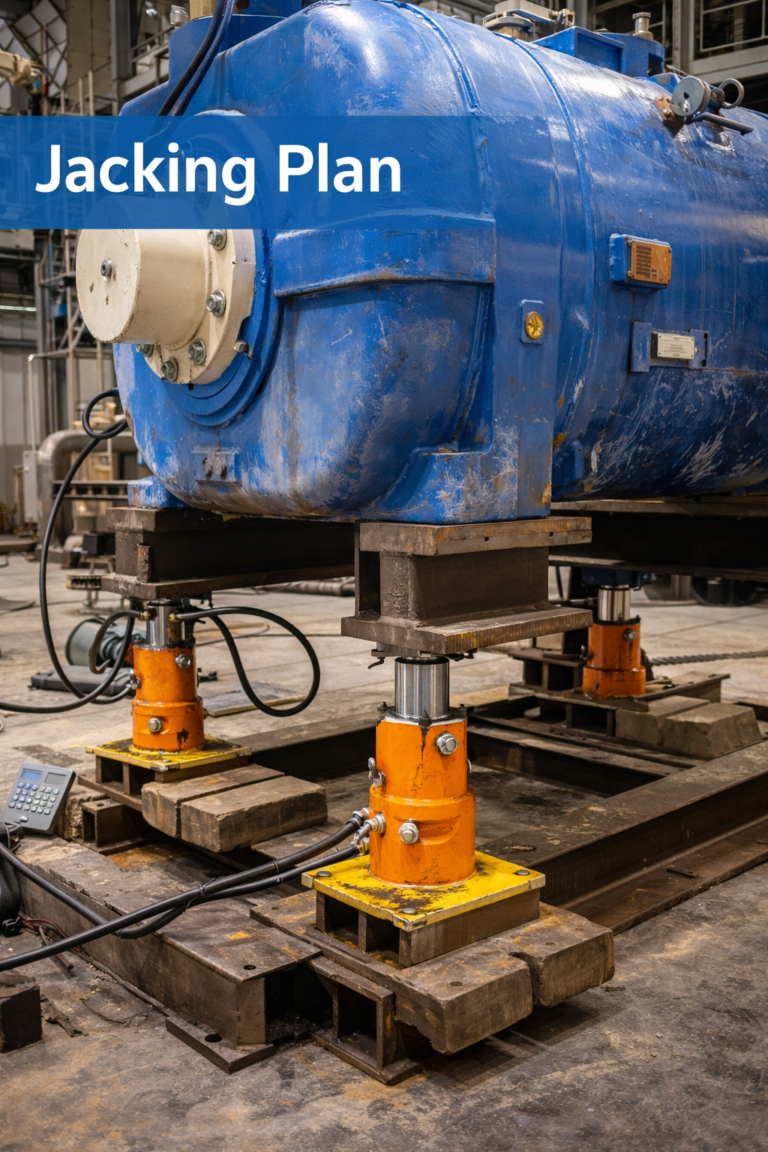
Jacking plan usually refers to method of lifting and supporting heavy equipment through the use of hydraulic or mechanical jacks especially when cranes are not available or practical.
Sometimes, jacking is the only feasible or even the safest method in a lot of situations. Jacking is generally done when the load is heavy and needs to be lifted slowly or when the work space is very limited or when the machine has to be exactly leveled.
In contrast to cranes that suspend loads from above, jacks elevate machines by pushing from below. That is why jacking calls for very precise engineering. Even a tiny error in load distribution or jack placement can cause one side to be lifted more than the other, equipment to move unexpectedly or excessive load to be put on the building or on the machine itself.
Besides, the ground bearing capacity must be taken into consideration since if, the ground under the jacks does not have enough strength, sinking or unstable condition will be resulted during the lift.
To prevent these risks, engineers develop a detailed jacking plan that carefully controls every stage of the lifting process. A proper jacking plan typically includes:
- Machine weight and centre of gravity
- Jack load capacity and how many jacks will be needed
- Where the jack should be placed precisely
- Detailed instructions on the load transfer and the lifting sequence
- Safety allowances and emergency measures
In Singapore, machinery movements most of the time happen inside operational factories, data centres, and plants. In such situations, jacking plans are indispensable quite often since they enable heavy equipment to be safely lifted, levelled and moved without interrupting the surrounding operations or compromising safety.
What Is a Rigging Plan?
A rigging plan details how equipment is fastened, lifted, and supported in the process with the help of slings, shackles, spreader beams, and other rigging tools. At first glance, rigging might seem like a simple task. However, it is actually one of the most crucial parts of any lifting operation. The method of attaching a load to lifting gear determines stability, balance, and safety not just at the time of connecting but throughout the move as well.
Without proper rigging plans in place, significant issues may arise. Sling failures, off-balance load, or a sudden load shift can occur during the lifting process. No matter how powerful a crane or lifting equipment is, it cannot make up for wrong rigging. This is the reason why professional machinery movers depend on engineered rigging plans and not just guesswork or experience.
Before giving the green light to a rigging arrangement, engineers assess a long list of factors such as:
- Weight, dimensions, and shape of the load
- Locations of lift points and their capacity
- Angle of slings and resulting tensions
- Positioning of the centre of gravity
- Appropriate rigging gear for the operation
Proper rigging will keep the equipment stable, under control, and behave as expected right from the point it is lifted off the ground to when it is correctly set down. The difference between a flawless procedure and a disastrous one is sometimes just the rigging in the case of complicated or dangerous lifts.

How These Plans Work Together?
Swing plans, jacking plans, and rigging plans are not separate documents — they work as a complete system.
| Plan Type | Purpose |
|---|---|
| Swing Plan | Controls movement and rotation |
| Jacking Plan | Ensures stable lifting and support |
| Rigging Plan | Secures and balances the load |
If even one element is incorrect, the entire operation becomes risky.
That’s why professional engineering teams take the time to calculate, simulate, and validate every step before the actual move begins.
Need Help With Heavy Machinery Moving Planning?
Moving heavy machinery is never simply a matter of lifting and transporting. It also involves comprehension of the forces, movement, and the risk.
Swing, jacking, and rigging plans are the unseen groundwork for the safety, control, and success of machinery moves. Only when the engineering is done properly does everything else go on without a hitch.
Should you have a project with heavy or delicate machinery, partnering with a seasoned engineering-driven transport company will be very helpful. Contact Jaberson Technology for more info.
📧 Email: info@jaberson-technology.com
📞 Call : +65 6734 3992